6 September 2011

Who's Getting Their Way On Spending Cuts?

Before the general election, all the main parties agreed that the deficit needed to be tackled over the next 5 years. The country couldn't go on spending £1 in every 4 raised just on debt interest.

The IFS scrutinised the deficit reduction plans of the three main parties in the run up to polling day. They calculated that the Conservatives were pledging £96bn of spending cuts by 2015, while the Lib Dems would cut £80bn.

We now know that these two parties would form a Coalition government. In October they announced their Comprehensive Spending Review. Its figures show that the Coalition will cut £81bn from government spending by 2015.

I know my readers are intelligent souls, so I'll leave you to work out whether £81bn is closer to the Lib Dem £80bn or the Tory £96bn.

Let's not forget Labour in this. The IFS calculated they would make £82bn of spending cuts, only the slightest bit different from the Coalition's £81bn. Labour now oppose every single cut the Coalition is making.

1 September 2011

Another Anti-Immigration Myth Blown Out Of The Water

This was the Daily Express's frontpage on November 2nd 2007.


This myth has been circulated in our mainstream media for the last four years. There are more examples here, here, here, here, here, here, here, here, here, here and here.

Oh and here:


It is total nonsense. The 'maths' to make this myth work is basically equivalent to saying 2 - 2 = 4.

Thankfully, Left Foot Forward has today brilliantly destroyed this argument by doing the same calculation with disabled people.They took 219% of all new jobs last year!

27 August 2011

The Net Migration Trap

Fraser Nelson's analysis of the latest net migration statistics is generally sound:

He correctly identifies that "the inflow to Britain has stayed steady, but the number emigrating from Britain has fallen" (which many other journalists got wrong).

He also states that "Cameron has a snowballs's chance in hell of meeting his target" of reducing net migration to the tens of thousands. That's true too. The immigration reforms brought in by the Coalition will already be deeply damaging on both an economic and humanitarian level. But they don't go far enough to cut net migration to such a low level. ConservativeHome's Tim Montgomerie has spotted why: "At every turn the Lib Dems have frustrated Damian Green and Theresa May's efforts". I'm appalled by what has been done to the already horrid immigration system left by Labour, but I dread to think how awful it would get if the Tories weren't reined back by the Lib Dems.

However, some of Fraser Nelson's analysis raises more questions than it answers. He decides that "Cameron should only ever have pledged to stem the inflow". This is problematic though, in two ways.

First, it changes your motives for wanting reforms to the system. If you are worried about immigration because of the pressure it puts on public services, infrastructure, the number of jobs available to British workers, these are better dealt with by looking at net migration, as this tracks the change in population size. If you only want to cut immigration, it changes your agenda to the more cultural arguments against immigration. It would be hard to defend such a policy without sounding like Enoch Powell.

Second, the government can only control non-EU immigration. EU immigration, after a lull during the recession, is back to its mid-2000s strength. It could even be that reducing non-EU immigration causes EU immigration. Oops!

Fraser Nelson also uses this odd argument - "Governments of free countries can't stop people emigrating". Why is it a right for people to migrate in one direction but not the other? (Of course what's really happening is that the government is responding to voters' selfish demand that they can move freely whilst insisting other people can't. That's nothing to do with freedom.)

So it would appear the government is trapped by its own net migration target. They even had a golden opportunity to make life much easier for themselves when the Home Affairs Select Committee suggested removing foreign students from the immigration statistics (they are much more like visitors than migrants). The government rejected the offer. Talk about own goals! Fraser Nelson says that Cameron "deserves the flak he'll get". Quite.

But we are where we are. Labour's already tight immigration policy will be further tightened by this government. The reality is that migration is a natural part of an increasingly interconnected world. Our border controls are futile against this overwhelming force. There's evidence that the wasted human potential created by immigration controls is stopping a boost to global GDP of between 67% and 147%. That's $39 trillion at the bottom end. The global economy could really do with that boost right now.

10 August 2011

Why Don't CAMRA Practice What They Preach?

CAMRA have a long history of saying they promote responsible, healthy drinking. Their latest press release is no exception:

At the Great British Beer Festival today, CAMRA, the Campaign for Real Ale, has welcomed the Government's decision to introduce a 50% excise duty reduction on beers at or below 2.8% ABV from October 2011 in a move that will allow consumers to enjoy a lower priced and lower strength pint in their local.

CAMRA predicts the introduction of low strength beers - dubbed the 'People's Pints' - in pubs could be a huge boost to the licensed trade in light of new consumer research - out today - showing how 1 in 2 regular pub goers would like to see more pubs selling a low strength beer option.

Building on the success of a campaign which CAMRA has been leading since 2009, further new research has shown how pub goers would like to see more pubs selling low strength beers due to factors such as the ability to help regulate drinking levels, their more refreshing taste, their low calorie content, and their lower cost.

Last weekend saw the CAMRA-run Great British Beer Festival, which showcases 300 of the UK's finest real ales. Therefore you would expect CAMRA would be keen to showcase these "People's Pints" at its grandest event.

I'm a real ale drinker myself, and while I've been to the Great British Beer Festival in several times in the past, I didn't make it this year, so I don't have a guide in front of me. Handily though, their website provides a complete list of all the beers available. I went through it, and discovered that not a single beer available at the Great British Beer Festival was below 2.8% ABV.

The lowest ABV beer available was Bateman's Dark Mild, 3% ABV (FYI, it's a Cyclops-style dark mild, black in colour with a roasted smell and taste). Once you get up to 3.4% ABV there was a good selection available.

I can't find the June 2011 CAMRA Omnibus Survey where the statistic comes from, but let's trust that it's true that 1 in 2 regular pub goers say they want these less alcoholic beers. However what people say they'll do and what people actually do are not the same thing. I strongly suspect that breweries know that only beers above 3% ABV will find a market.

One possibility is that 3% ABV is the flavour cut-off point. Anything below this tastes bland, and there is a minimum level of alcohol content required as a base to bring out those delicious, complex flavours. However, CAMRA's own press release contradicts this:

On the eve of the Great British Beer Festival CAMRA conducted a taste test to find out whether beer experts could differentiate between a low and mid strength real ale. In a tasting consisting of real ales from 2% to 3.5% ABV, even a panel of experienced drinkers did not manage to correctly differentiate the products.

Who am I to argue with the panel of experienced drinkers?

This therefore suggests a different rationale - real ale drinkers don't just drink for the flavour, they drink to get drunk. To be clear, I'm no puritan - indeed this explanation would correlate with my own experience of real ale drinking.

There's plenty of evidence to suggest that this is what's going on too. Looking at the other end of the ABV spectrum available at the Great British Beer Festival, we find:

Black Sheep Riggwelter (5.9% ABV)
Raw Grey Ghost IPA (5.9% ABV)
Titanic Nine Tenths Below (5.9% ABV)
Thornbridge's Jaipur IPA (5.9% ABV) and Raven (6.6% ABV)
Acorn Gorlovka (6% ABV)
Flowerpots IPA (6% ABV)
Peerless Full Whack (6% ABV)
Spectrum Old Stoatwobbler (6% ABV)
Twickenham's Daisy Cutter (6.1% ABV)
Greene King's Abbot Reserve (6.5% ABV), Old Crafty Hen (6.5% ABV) and Very Special IPA (7.5% ABV)
Elland 1872 Porter (6.5% ABV)
Brains' Strong Ale (6.5% ABV, "exclusively available at the GBBF")
Arbor's Yakima Valley American IPA (7% ABV)
Inveralmond Blackfriar (7% ABV)
All Gates Mad Monk (7.1% ABV)
Brodies' Superior London Porter (7.1% ABV)
Yates' Yule Be Sorry (7.6% ABV)

All are more than double the 2.8% ABV CAMRA say they promote. And those are just the casks. For that extra-special headache, there's always a bottle of O'Hanlon's Brewer's Special Reserve 2010 (12.9% ABV).

Finally, here's a photo from that you'll see on all the pages their website:


'Nuff said.

CAMRA need to drop the pretence. They should acknowledge that their members like getting drunk.

This Is The Youth Of Today

9 August 2011

Yesterday on Twitter... #londonriots

I went through three stages of emotion looking at my Twitter feed yesterday - confusion, amusement, and then downright despair. I find it hard to comprehend what's been going on in London, what motivates these rioters, what the cause is. Twitter answered none of these questions. What it did expose was how nasty and callous some political activists can be.

I must first address the jokes. Most were tasteless, some were stupid, few were funny, and all were unnecessary. I can understand why people make jokes in an incomprehensible situation. It's a way of coping. But looking back over them, I can't help feel that those who wrote them probably ought to question their appropriateness. I'm one of them. I tried to make light of the heaviest of situations. I shouldn't have.

However what really angered me, and what provoked me into hitting the 'new post' button right now, is seeing the political agendas being tagged onto these horrid events. I saw my allies do it as well as my opponents.

Left wingers stated that this proved that the government's cuts were having devastating repercussions.

Right wingers stated that this proved that multiculturalism has failed, and that the youth of today had no morality.

Liberals stated how this proved that allowing the government to tread on our civil liberties causes serious repercussions.

Fascists stated how this proved that immigration had ruined our way of life and must be stopped.

Anarchists stated how this proved that if the government is allowed to steal property, it will mean citizens stealing each other's property too.

I saw all of these exclamations yesterday. If I was being kind, I'd file these opinions as "guesswork at best". As they tumbled onto my screen, I tried to make sense of them. But it was like trying to find meaning in randomly generated numbers. As they continued pouring in, it actually became funny. I began chuckling at the desperation some people clearly must feel to constantly justify their political persuasion. But they didn't stop. As London went up in flames, along with countless livelihoods, there were still people determined to manipulate the situation to preach their political gospel.

Why are these people interested in politics? I thought the whole point of it was to secure positive outcomes for people's lives. When the worst hits, and all you're thinking of is the propaganda, why are you doing it?

There are so few facts about what is going on and the events that led up to it that we can't draw any conclusions. I don't pretend to have no gut instincts myself, but no-one needs to know about the contents of my gut. The only thing I know for certain is that anyone drawing proof of any underlying political argument from this is telling you more about themselves than they are about society.

And yes, it may be that one or two of the answers that are out there may turn out to be accurate. I can guarantee that whoever wrote them will let you know about the accuracy of their insight. But that random number generator will also occasionally give the correct solution to a problem too.

5 August 2011

Full Text of the Lib Dem Conference Drug Decriminalisation Motion

Protecting individuals and communities from drug harms

Conference notes:

1) That drugs are powerful substances which can have serious consequences for the individual user and society in general; and that it is therefore right and proper that the state should intervene to regulate and control the use of such substances as it does the consumption of legal drugs such as alcohol and tobacco and both prescription and over the counter medicines.

2) That the misuse of drugs can blight the lives of individuals and families and the purchase of illegal drugs can help to fuel organised crime.

3) The need for evidence-based policy making on drugs with a clear focus on prevention and harm-reduction.

4) There is increasing evidence that the UK’s drugs policy is not only ineffective and not cost effective but actually harmful, impacting particularly severely on the poor and marginalised.

Conference further notes:


A. The positive evidence from new approaches elsewhere including Portuguese reforms that have been successful in reducing problematic drug use through decriminalising possession for personal use of all drugs and investing in treatment programmes.

B. That those countries and states that have decriminalised possession of some or all drugs have not seen increased use of those drugs relative to their neighbours.

C. That heroin maintenance clinics in Switzerland and The Netherlands have delivered great health benefits for addicts while delivering considerable reductions in drug-related crime and prevalence of heroin use.

D. The contribution of the ACMD to the 2010 Drug Strategy consultation which states that“people found to be in possession of drugs (any) for personal use (and involved in no other criminal offences) should not be processed through the criminal justice system but instead be diverted into drug education/awareness courses or possibly other, more creative civil punishment”.

E. The report of the Global Commission on Drug Policy whose members include former UN Secretary General Kofi Annan, former heads of state of Colombia, Mexico, Brazil and Switzerland, the current Prime Minister of Greece, a former US Secretary of State and many other eminent world figures, which encouraged governments to consider the legal regulation of drugs in order to, “undermine the power of organised crime and safeguard the health and security of their citizens”.

F. That the United Kingdom remains bound by various international conventions and that any re-negotiation or new agreements will require international co-ordination.

Conference believes:

i) That individuals, especially young people, can be damaged both by the imposition of criminal records and by a drug habit, and that the priority for those addicted to all substances must be health care, education and rehabilitation not punishment.

ii) Governments should reject policies if they are demonstrated to be ineffective in achieving their stated goals and should seek to learn from policies which have been successful.

iii) At a time when Home Office and Ministry of Justice spending is facing considerable contraction, thereis a powerful case for examining whether an evidence-based policy would produce savings allowing the quality of service provided by these departments to be maintained or to improve.

iv) That one of the key barriers to developing better drugs policy has been the previous Labour government’s persistent refusal to take on board scientific advice, and the absence of an overall evaluative framework of the UK’s drugs strategy.

v) That the Department of Health should take on a greater responsibility for dealing with drugs.

Conference calls for:

a) The Government to immediately establish an independent panel tasked with carrying out an Impact Assessment of the Misuse of Drugs Act 1971, to properly evaluate, economically and scientifically, the present legal framework for dealing with drugs in the United Kingdom.

b) The Panel should also consider reform of the law, based on the Portuguese model, such that i) possession of any controlled drug for personal use would not be a criminal offence;

ii) possession would be prohibited but should cause police officers to issue citations for individuals to appear before panels tasked with determining appropriate education, health or social interventions.

c) The panel should also consider as an alternative, potential frameworks for a strictly controlled and regulated cannabis market and the potential impacts of such regulation on organised crime, and the health and safety of the public, especially children.

d) The reinvestment of any resources released into effective education, treatment and rehabilitation programmes.

e) The widespread provision of the highest quality evidence-based medical, psychological and social services for those affected by drugs problems. These services should include widespread availability of heroin maintenance clinics for the most problematic and vulnerable heroin users.

30 July 2011

Dark Days


Well it's hard to be happy
in a world that's so cruel
where the weak just get weaker
where the powerful feud
where the children go hungry
while the soldiers stand by
lay down your weapons
take hold of your lives
and when will we learn
that it's hate that breeds hate
only love is the cure
don't leave it too late
get up, and feel it
the truth that won't wait
if we choose to do nothing
then we take all the blame.

27 July 2011

HS2, WCML & FPTP

First, a breakdown of those acronyms:

HS2 = High Speed 2, a proposed high speed rail link that will directly London Euston to Birmingham, then later to Manchester (and Leeds).


WCML = West Coast Main Line, an existing rail link connecting London Euston to Birmingham and Manchester (and than up to Scotland). It also has stations at many other places in between. It's the most important railway line in the UK.


FPTP = First Past The Post, the electoral system used for general elections. The UK is split up into 600 constituencies, and each elects a single MP with the most votes. Most constituencies are safe seats where the same party always wins, but a few are marginal seats where the constituency frequently changes hands. It's the marginal seats which pick who governs, so the views of the swing voters here count more than anywhere else.

There is a big dispute over whether or not HS2 should be built. Opponents point to its £30bn price tag and the damage it will do to the countryside. Proponents emphasise the prospects for

The WCML carries all sorts of trains. As well as some services stopping at the towns on its path, it is used for the current fastest services from the major cities to London. The diagram below shows a typical hour use of the line.


The key thing to note is how many trains full of intercity passengers zoom straight past places like Crewe, Rugby, Northampton, Milton Keynes and Watford. HS2 provides a better alternative for these trains, freeing up capacity for trains to serve large towns. It is in the self-interest of people in these towns to see HS2 built.

The people whose self-interest is not served by HS2 are the people who live in the small towns and rural areas that the line will speed through but not stop anywhere near. However I'm unaware of the proposed HS2 route going anywhere near a marginal seat. The route seems to be entirely through Tory safe seats.

Conversely, the WCML-served Crewe, Rugby, Northampton, Milton Keynes and Watford are all towns containing marginal seats. So in order to gain power, it is in the self-interest of politicians to prioritise the views of residents of these places at the expense of the residents in safe seats.

To the lobbyists campaigning for HS2's construction, I'd be making sure that the residents of the WCML towns are aware of the benefit HS2 will bring them. The politicians will respond accordingly.

15 July 2011

How Tabloid Misinformation Makes Our Country Worse

Our understanding of the world comes from the media. Yet opinion polls that ask about how things are show the public are highly misinformed.

Here is a clear example of this effect:

Asked to estimate the proportion of foreign-born people living in the UK, the average guess is 29.4%. The true figure according to OECD data is 10.8%, lower than Germany, Spain, the Netherlands, Canada and the USA.

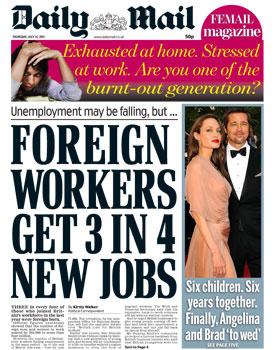
How do the public become so misinformed about the scale of immigration?

Here is yesterday's Daily Mail frontpage:

Millions of people will have seen this frontpage headline. However, the numbers are simply untrue. The Office of National Statistics has started to explicitly tell reporters that it is incorrect to use their figures in this way, after countless instances of misreporting by the tabloid press. The Daily Mail deliberately ignored this warning.

This has been going on for many years, and a false perception is created. The government, keen to appease the negative feelings generated by this misinformation, therefore has to respond with promises to reduce net migration to below 100,000.

The consequences of their immigration clampdowns are numerous on both a human and economic level. The latest student visa restrictions will cost the economy around £2.4bn - money we can ill-afford to lose in these uncertain economic times. The family visa restrictions will mean the ability to live with a foreign partner with will depend on income - your wedding vows may have said "for richer or for poorer", but that will now legally not be the case for some.

I could have written a similar article on other issues, for instance law and order. The tabloids lie to us, the public demand action based on misinformation, and the government act on false perceptions rather than the reality.

Never mind the celebrity gossip - this is how the tabloids make our country worse. I welcome the demise of the News of the World, and hope the rest of the gutter press follows suit.